events

Sketching the Architecture of Change

2026 APRI Forum

Yerevan, Armenia The best way to predict the future is to design it. R. Buckminster Fuller Amidst the chaotic fractures of the global order, Yerevan’s figurative and physical landscape is changing. A new layout is emerging. And, paradoxically, in this volatility, Armenians’ reliance on crisis management is being replaced by a more forward-looking confidence. The time to sketch the first drafts of our future has come. The theme for APRI Armenia’s 2026 Yerevan conference is “Sketching the Architecture of Change.” It will provide a platform for engagement on the fundamental building blocks required to boost Armenians’ agency and secure a sovereign future. The 2026 APRI Forum will bring together policy, diplomatic, private sector, civil society leaders and engaged Armenians to investigate the way forward for Armenia in key areas of development. The program will feature multidisciplinary discussions and in-depth keynote sessions with officials and foreign guests throughout the three days. https://vimeo.com/1121812338

2026 APRI Forum Read More »

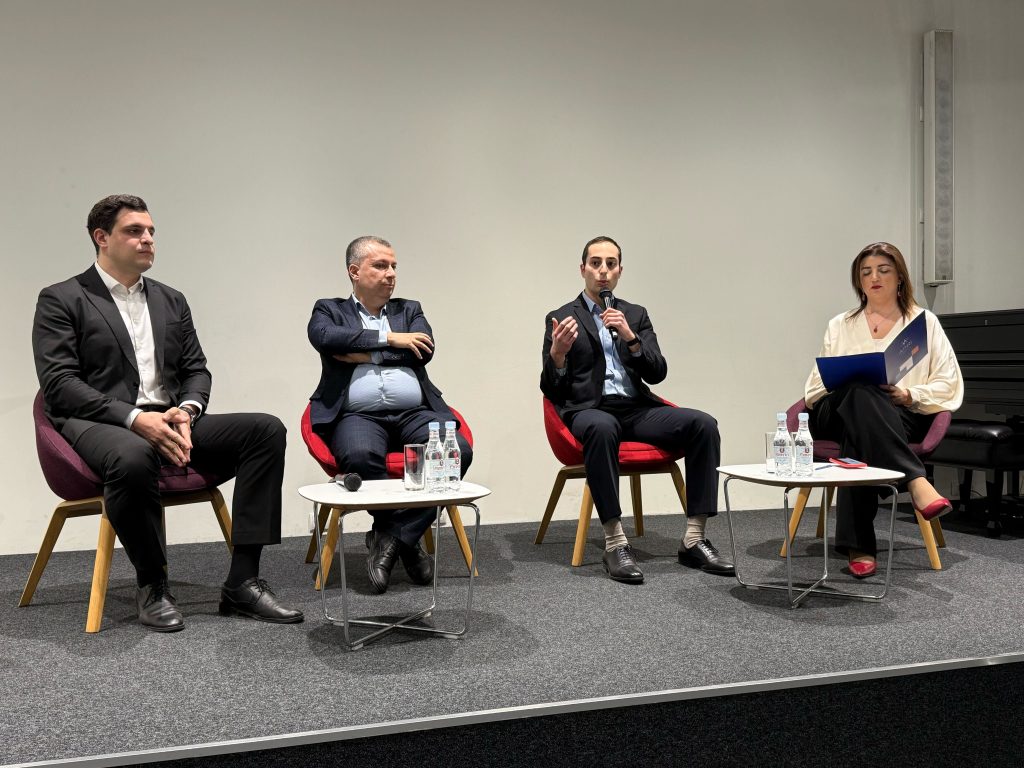
An APRI Armenia Panel Discussion on Türkiye’s Policy in the South Caucasus Took Place

APRI Armenia’s Young Leaders Townhall Yerevan, Armenia On February 24, APRI Armenia held an interactive townhall on Türkiye’s policy in the South Caucasus and Armenian-Turkish relations for young leaders. The event brought together students specializing in international relations and political science from various universities in Armenia. Program Opening Remarks by Anahide Pilibossian, Vice President for Strategy and Development Research Presentation by Benyamin Poghosyan, Senior Research Fellow Panel discussion Shant Arzoumanian, Senior Associate Fellow, APRI Armenia Sergei Melkonian, Research Fellow, APRI Armenia Benyamin Poghosyan, Senior Research Fellow, APRI Armenia Moderated by Nvard Chalikyan, Research Fellow, APRI Armenia

An APRI Armenia Panel Discussion on Türkiye’s Policy in the South Caucasus Took Place Read More »

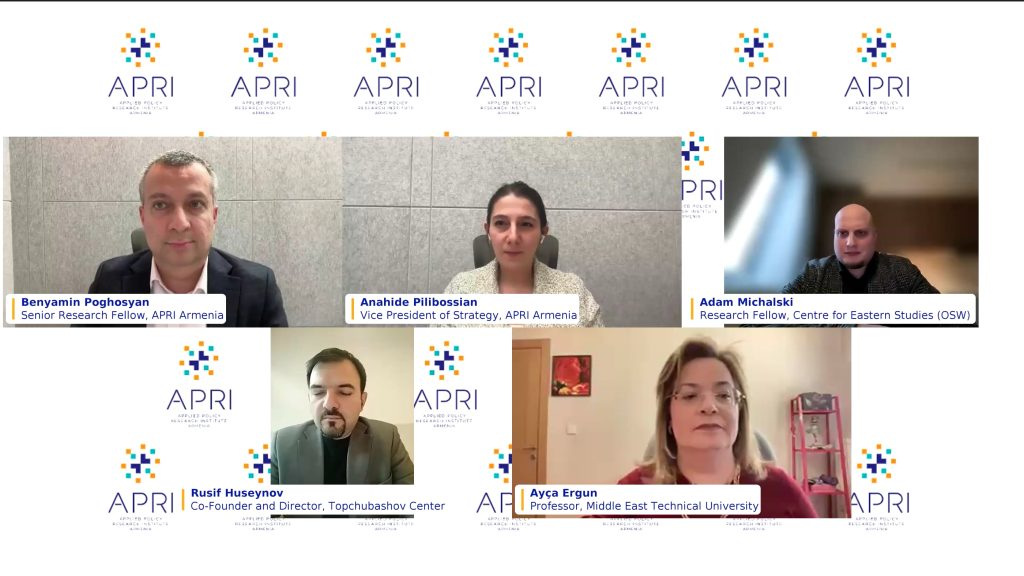
Türkiye’s policy in the South Caucasus

APRI Virtual Town Hall https://vimeo.com/1147795323    Panelists: Aycha Ergun, Professor, Middle East Technical University Adam Michalski, Research Fellow, Centre for Eastern Studies (OSW) Rusif Huseynov, Co-Founder and Director, Topchubashov Center Benyamin Poghosyan, Senior Research Fellow, APRI Armenia Moderator: Anahide Pilibossian, Vice President of Strategy and Development, APRI Armenia

Türkiye’s policy in the South Caucasus Read More »

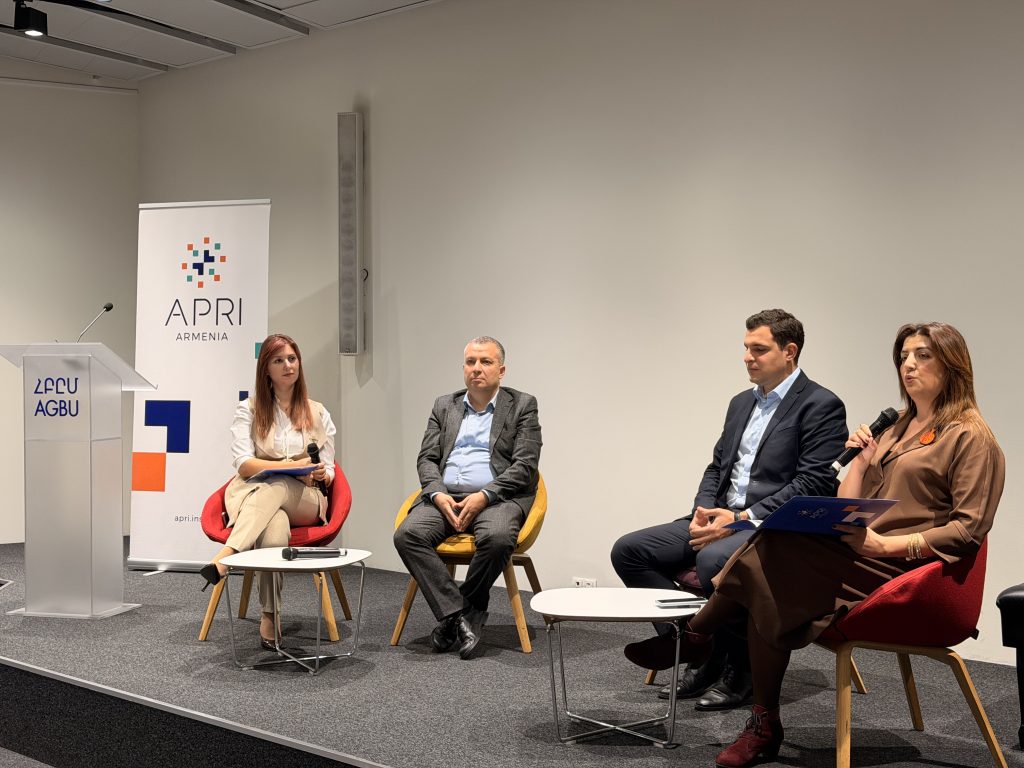
APRI Armenia Brought Together Students to Discuss Armenia’s Foreign Policy Diversification

Panel discussion by APRI Armenia Yerevan, Armenia On November 11, APRI Armenia hosted an interactive discussion titled “Diversification of Armenian Foreign Policy and Changing Regional Geopolitics” with students specializing in International Affairs and Political Science at various Armenian universities. Program Opening remarks by Greta Avetisyan, Communications Manager, APRI ArmeniaPresentation of research findings by Benyamin Poghosyan, Senior Research Fellow, APRI Armenia Panel discussion Benyamin Poghosyan, Senior Research Fellow, APRI Armenia Nvard Chalikyan, Research Fellow, APRI Armenia Sergei Melkonian, Research Fellow, APRI Armenia Moderated by Greta Avetisyan, Communications Manager APRI Armenia

APRI Armenia Brought Together Students to Discuss Armenia’s Foreign Policy Diversification Read More »

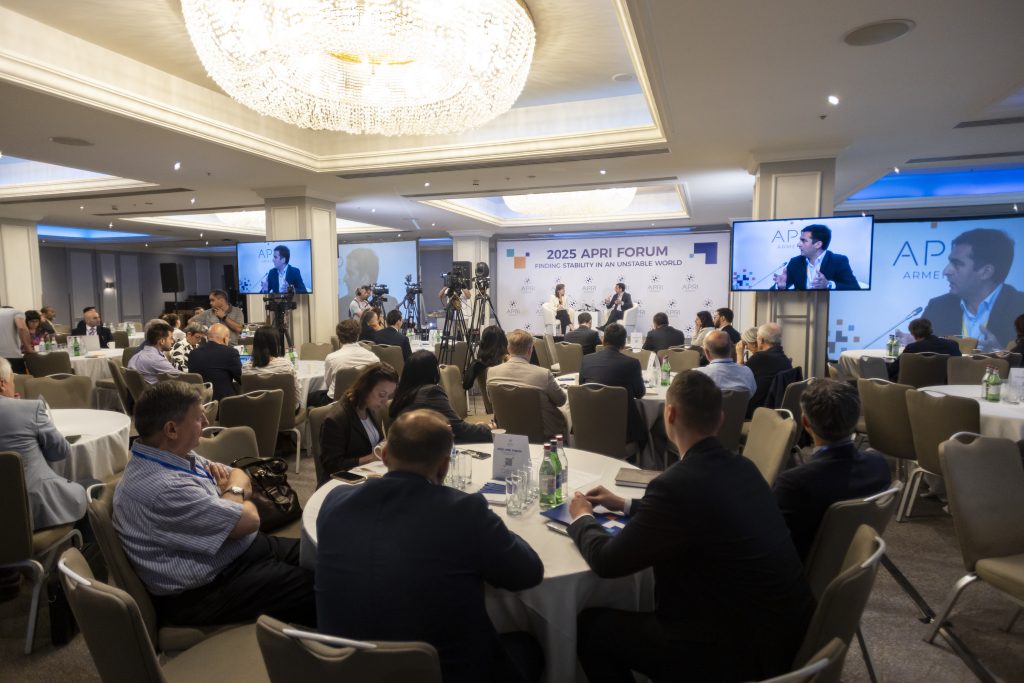
2025 APRI Forum

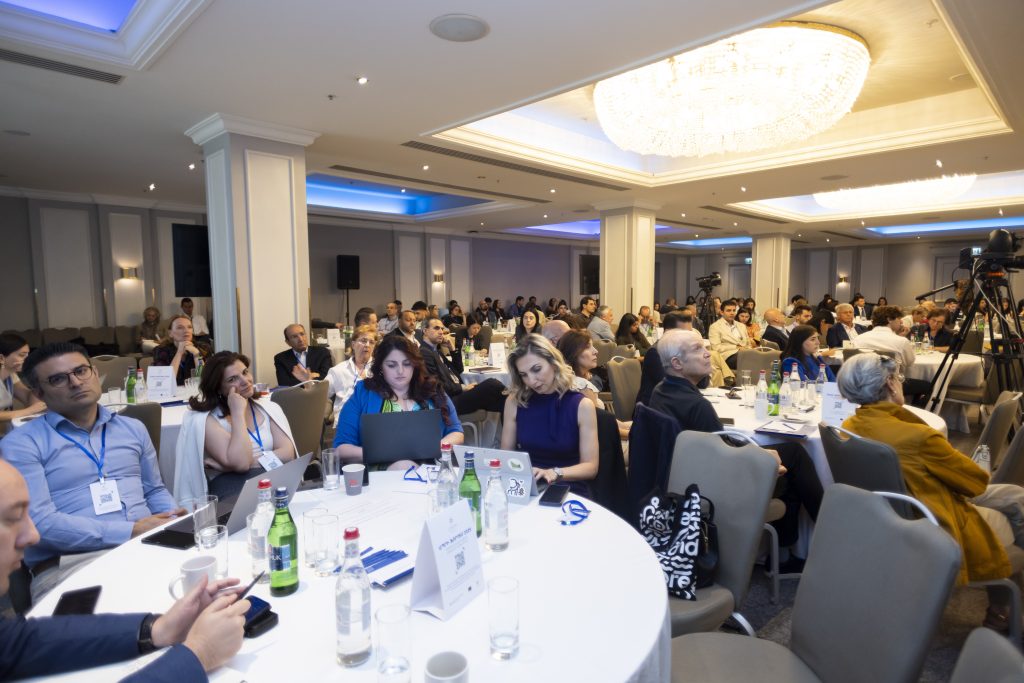
Yerevan, Armenia The 2025 APRI Forum, with the theme “Finding Stability in an Unstable World,” took place June 11–13 in Yerevan. It offered in-depth and thought-provoking conversations on the global uncertainties shaping Armenia and the South Caucasus. With ongoing conflicts in Ukraine and the Middle East, the political metamorphosis under the Trump administration, and persistent instability, the Forum provided a place to think through and discuss these challenges and how to navigate them. The three-day conference brought together policymakers, diplomats, business leaders, civil society representatives, and engaged Armenians to address a range of critical issues—from fostering technology and investments and advancing energy security to navigating shifting geopolitics and strengthening civic engagement. Thought leaders from various fields debated over actionable recommendations to confront Armenia’s challenges in an increasingly volatile world.  https://vimeo.com/1121812338 Quotes that inspired us: “As you start to walk on the way, the way appears.” Rumi   “Every great dream begins with a dreamer. Always remember, you have within you the strength, the patience, and the passion to reach for the stars to change the world.” Harriet Tubman   “I’m a pessimist because of intelligence, but an optimist because of will.” Antonio Gramsci, Letter from Prison, December 1929  Forum Agenda June 11 June 12 June 13 9:25 Welcome and Opening Remarks Lara Setrakian, President, APRI Armenia 9:30 Stability through Technology and Innovative Partnerships  In this opening session of the 2025 APRI Forum, Hakob Arshakyan, Vice President of the National Assembly, shares Armenia’s vision for finding stability in an unstable world through enhanced focus on technology and innovative partnerships. Hakob Arshakyan, Vice President, National Assembly of the Republic of Armenia Moderator: Arda Haratunian, Board Member, APRI Armenia, AGBU, AUA and Adjunct Professor, Queens College 10:00 APRI Armenia’s Foreign Policy Report: Diversification in the Post-Unipolar World APRI Armenia’s foreign policy report traces Armenian foreign policy developments since the 2020 Nagorno-Karabakh War and examines the challenges in diversifying and deepening diplomatic, economic, and security relationships in the last four years. With the launch of this report, APRI Armenia provides an analysis of Armenia’s foreign policy diversification and offers recommendations on how the next phase can address ongoing geopolitical uncertainties. Benyamin Poghosyan, Senior Research Fellow, APRI Armenia Moderator: Anahide Pilibossian, Vice President, Strategy and Development, APRI Armenia 10:15 Decoding the Global (Dis)Order From wars in Ukraine, the Middle East, and other regions to a shattered global trade system, uncertainty is worsening. This session will focus on growing instability in the global order and how different and sometimes competing powers are responding to these changes. Iskander Akylbayev, Chief Executive Officer, Xander Group Alok Bansal, Director, India Foundation Evgeniya Goryushina, Researcher at the Centre for Comprehensive European and International Studies (CCEIS), HSE / Head of the Caucasus Studies Sector (ICCA RAS) Stefan Meister, Head of the Center for Order and Governance in Eastern Europe, Russia, and Central Asia, German Council on Foreign Relations, DGAP Moderator: Benyamin Poghosyan, Senior Research Fellow, APRI Armenia 11:00 Coffee Break 11:30 Armenia–Azerbaijan Negotiations: Prospects for Progress Peace remains Yerevan’s top priority after the turbulence of recent years but the outstretched hand has often been met with a closed fist. Few signs suggest progress will be made toward a peace agreement with Azerbaijan this year—even as Armenia builds on its policy of constructive engagement while boosting deterrence. In conversation with Armenian experts, Rusif Huseynov, from the Topchubashov Center, presents the view from Azerbaijan on prospects for negotiations and regional peace. How will Baku respond and does it see any reason to make peace? Is no peace/no war the best the region can expect in the short- to mid-term perspective? Tatevik Hayrapetyan, PhD in History, Expert in Azerbaijani Studies Rusif Huseynov, Co-Founder and Director, Topchubashov Center (Zoom) Moderator: Benyamin Poghosyan, Senior Research Fellow, APRI Armenia 12:15 Armenia–Turkey Normalization and the Quest for Regional Stability Despite high-level announcements, the Armenia–Turkey normalization process is at a standstill. Turkish President Recep Tayyip Erdoğan links normalization with Ankara to the signing of a peace agreement between Armenia and Azerbaijan, leading to a seeming deadend. What is behind this and are there any prospects for change? How might a less Azerbaijan-focused Turkish foreign policy impact the region? Can external actors, including Europe, Russia, the United States, and Iran, provide effective support for Armenia–Turkey normalization? Mitat Çelikpala, Vice-Rector, Kadir Has University (Zoom) Varuzhan Geghamyan, Associate Professor, Chair of Turkic Studies, Yerevan State University Moderator: Anahide Pilibossian, Vice President, Strategy and Development, APRI Armenia 13:00 Networking Lunch & Musical Guests 14:00 Russia’s Foreign Policy and Russia–Armenia Dynamics Diplomatic relations between Yerevan and Moscow have intensified since mid-2024, while the economic relation remains strong. The need for a reset is now discussed between the two. How might Armenia and Russia capitalize on this moment? What are their mutual expectations? What role will Armenia, and the South Caucasus, take in Russia’s foreign policy? How will Armenia’s foreign policy diversification affect the Armenia–Russia relationship? Evgeniya Goryushina, Researcher at the Centre for Comprehensive European and International Studies (CCEIS), HSE / Head of the Caucasus Studies Sector (ICCA RAS) Moderator: Leonid Nersisyan, Senior Research Fellow, APRI Armenia 14:45 Prospects for Iran–Armenia Relations Relations between Iran and Armenia are reaching a new level, with Iran a key partner for Armenia’s connectivity and security. Maintaining open trade with its neighbor is vital, as is Iran’s opposition to Azerbaijani plans for the so-called “Zangezur Corridor.” However, US pressure on Iran may intensify if the two sides cannot reach a new deal on nuclear restraints. In the wake of this uncertainty, how can Yerevan and Tehran continue to build upon their partnership? How does Iran view its foreign policy in the South Caucasus amid relations with regional and nonregional actors? Sergei Melkonian, Research Fellow, APRI Armenia Seyed Mohammad-Kazem Sajjadpour, Distinguished Senior Fellow, Institute for Political and International Studies Moderator: Anahide Pilibossian, Vice President, Strategy and Development, APRI Armenia 15:30 Understanding Europe’s Outlook on the South Caucasus Trade and security tensions between Europe and the United States are heightening as European leaders look to develop their strategic autonomy. The European Union

2025 APRI Forum Read More »

APRI Armenia Public Administration Reform Report Launch Event

A pilot project by APRI Armenia Yerevan, Armenia APRI Armenia has released its new report, Better Policy: Reforms to Armenia’s Public Administration, the outcome of a six-month research project. The study draws on nearly 40 interviews with key stakeholders both in Armenia and abroad to evaluate the implementation of the Public Administration Reform Strategy and to identify structural and cultural obstacles to effective policymaking. The pilot project concludes with a roadmap of targeted recommendations to help address the issues identified during the research. Programme Welcoming remarks by Anahide Pilibossian, Vice President of Strategy and Development, APRI Armenia Opening remarks by Edgar Mkrtchyan, Head of Deputy Prime Minister Mher Grigoryan’s Office Presentation of the research findings by Hovsep Babayan, Research Fellow in Public Administration Reforms, APRI Armenia Fireside chat with Egle Rimkute, Senior Policy Advisor, OECD/SIGMA (online) Panel discussion Lilya Afrikyan, Head of Participatory and Open Governance Department, Office of the Prime Minister of the Republic of Armenia Tigran Jrbashyan, Partner, Director of Management Advisory, Ameria Advisory Hrachik Yarmaloyan, Regional Component Manager for the Eastern Partnership on Service Delivery/Digital Transformation, Regional Project “Public Administration Reform in the EaP Countries”/ National Coordinator in Armenia, GIZ Armenia Moderated by Hovsep Babayan, Research Fellow, APRI Armenia

APRI Armenia Public Administration Reform Report Launch Event Read More »

Panel Discussion on Armenia–EU relations

Joint event organized by Ghent University’s Eureast Platform and APRI Armenia with the support of the Belgian Embassy to the Republic of Armenia Yerevan, Armenia APRI Armenia co-organized an event on Armenia–European Union relations in partnership with Ghent University’s Eureast Platform, with the support of the Embassy of Belgium in Armenia. The event brought together key figures, experts, and stakeholders to discuss Armenia’s evolving geopolitical positioning and its relations with the EU.The panel discussion explored key issues surrounding Armenia’s path toward deeper EU integration. The two sessions investigated Armenia’s geopolitical positioning and EU–Armenia relations, including human rights promotion and the implementation of the bilateral Comprehensive and Enhanced Partnership Agreement. The challenges and opportunities facing Armenia on its potential path toward EU accession were also discussed. Session 1: Geopolitical Landscape and EU Relations with Armenia H.E. Eric De Muynck, Belgium’s Ambassador to Armenia H.E. Vassilis Maragos, Head of the EU Delegation to Armenia Anahide Pilibossian, Vice President, Strategy and Development, APRI Armenia Moderator: Fabienne Bossuyt, Associate Professor and Co-Coordinator of the Ghent Institute for International and European Studies Session 2: EU Support for Human Rights and Armenia’s Potential Path to EU Accession Laura Luciani, Postdoctoral Researcher, Ghent Institute for International and European Studies H.E. Ambassador Samvel Mkrtchian, Head of European Department, Armenian Foreign Ministry Tomasz Ostropolski, Deputy Head of Political, Press and Information Section, EU Delegation to Armenia Peter Van Elsuwege, Professor of EU Law and Jean Monnet Chair, Ghent University Moderator: Fabienne Bossuyt, Associate Professor and Co-Coordinator of the Ghent Institute for International and European Studies

Panel Discussion on Armenia–EU relations Read More »

APRI Armenia and ORF Collaborate on a Side Event at the 2025 Munich Security Conference

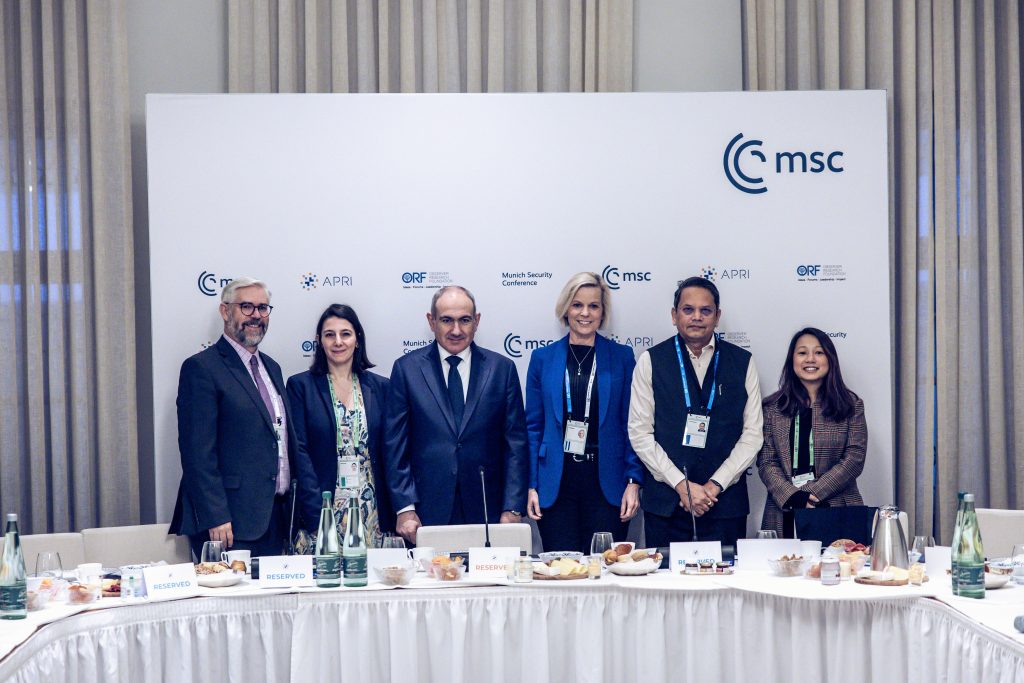
MSC side event by APRI Armenia Munich, Germany Are multilateral organizations still relevant in a network-based world order, shaken by US President Trump’s stance on multilateralism?APRI Armenia contributed to this ongoing debate, taking place at the 2025 Munich Security Conference (February 14, 2025), with a side event on “Minilateralism and the Shift from Global Alliances to Targeted Partnerships,” held in partnership with the Observer Research Foundation. Program Keynote speech by Nikol Pashinyan, Prime Minister of Armenia Speakers Dr. Vijay Chauthaiwale, Head of the Foreign Policy Department of the Bharatiya Janata Party Professor L. Gordon Flake, Chief Executive Officer of the Perth USAsia Centre at The University of Western Australia Dr. Anna Wieslander, Director for Northern Europe at the Atlantic Council and Head of its Stockholm office Moderator: Anahide Pilibossian, Vice President of Strategy and Development, APRI Armenia The side event brought together government officials, diplomats, academics, and private-sector representatives around critical conversations on the future of security alliances. 

APRI Armenia and ORF Collaborate on a Side Event at the 2025 Munich Security Conference Read More »

Outcomes Report Of The Ori Dialogues Project

“Ori Dialogue” Project to foster Armenian–German collaboration on green transition, nutrition, and digital literacy Yerevan, Armenia In collaboration with Berlin based Candid Foundation, the Applied Policy Research Institute of Armenia (APRI Armenia) organized a series of thematic, multi-stakeholder workshops for a project under the German Foreign Office’s Civil Society Cooperation program. The workshops convened a diverse group of environmental, health, and technology experts, including civil society representatives, policy advisers, and other key stakeholders from Armenia and Germany. Their primary aim was to facilitate knowledge exchange, foster networking, and develop solutions to pressing challenges in green transition, nutrition policy, and digital literacy. The project ran from September 2024 to December 2024. Three one-day thematic workshops were held—two dedicated to each topic—with approximately 12 participants per theme. The workshops took place in Yerevan on November 25, 2024, and Berlin on December 6, 2024. Each session focused on exchanging best practices, promoting cooperation, and building a network of experts specializing in the key policy areas identified. This outcome report summarizes the discussions, main findings, and recommendations. Notably, areas of cooperation were identified for targeted projects that align with one of the project’s central objectives: partnership-building. Download the report Partners

Outcomes Report Of The Ori Dialogues Project Read More »

Roundtable in San Francisco on Emerging Technologies

Roundtable discussion in San Francisco on the role of emerging technologies. San Francisco, USA APRI Armenia, in collaboration with the Observer Research Foundation America and the Observer Research Foundation, hosted a roundtable in San Francisco. The event called Global Diaspora Forum brought together leaders from the Indian and Armenian diasporas to engage in a thoughtful dialogue on the role of emerging technologies in driving economic growth and influencing global geopolitics.The dialogue explored ways to leverage diaspora networks for a more resilient future and examined the impact of the Bay Area’s tech sector on US foreign policy post-2024. The meeting highlighted the importance of India–Armenia partnerships in tech and entrepreneurship for Armenia’s development. Distinguished speakers of the roundtable: Hakob Arshakyan, Vice President of the Armenian National Assembly Dhruva Jaishankar, Executive Director of the Observer Research Foundation America Samir Saran, President of the Observer Research Foundation Moderator: Yervant Zorian, Chief Architect, Synopsys, Chairman of the Board of Trustees, APRI Armenia The event was enriched by the contributions of all participants, whose insights and expertise added valuable perspectives to the conversation.

Roundtable in San Francisco on Emerging Technologies Read More »

Geopolitical Future of the South Caucasus

Joint launch event with Friedrich Naumann Foundation for Freedom Armenia Yerevan, Armenia APRI Armenia, in cooperation with the Friedrich Naumann Foundation for Freedom Armenia, undertook the study on “Geopolitical Future of the South Caucasus” from July to September 2024 to better understand the factors shaping the geopolitical future of the South Caucasus. The project involved the active participation of Armenian, Georgian, and Azerbaijani experts through interviews and a closed roundtable discussion and provided recommendations to transform the South Caucasus into a more stable, secure, and prosperous region. APRI Armenia Senior Research Fellow Benyamin Poghosyan presented the main findings of the report, emphasizing the need for cooperative regional initiatives. A panel discussion was held with: Ahmad Alili, Head of Research Department, Caucasus Policy Analysis Center Thomas Hacker, Member of German Bundestag, Free Democratic Party (FDP) Johnny Melikyan, Senior Research Fellow, Orbeli Analytical Center Olesya Vartanyan, South Caucasus Security Expert Moderator: Benyamin Poghosyan, Senior Research Fellow at APRI Armenia You can read the full report here Partners About our partner The Friedrich Naumann Foundation for Freedom (FNF) began its dialogue work in the South Caucasus in 1996 and has been implementing projects in Armenia since 2002. The FNF works as an innovation platform for liberal politics in more than 60 countries. Its work focuses on the freedom, responsibility, and dignity of every human being. The foundation supports the political, social, and economic institutions that make this possible: liberal democracy, the rule of law, the protection of human rights, and the social market economy.In Armenia, FNF’s work focuses on democratization and the protection of human rights. To this end, they offer political education activities to strengthen the participation of citizens. The foundation works with local partners to support them through cooperation. At the same time, the foundation promotes international dialogue and integrates Armenian interlocutors into liberal networks.

Geopolitical Future of the South Caucasus Read More »

2024 APRI New York Meeting

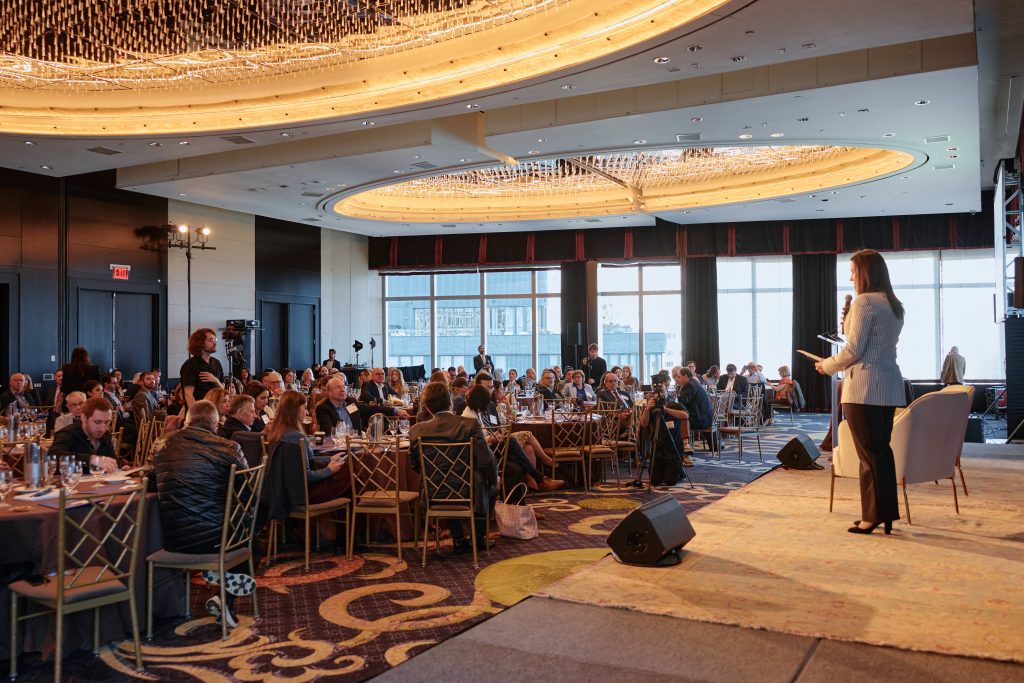
New York, United States of America APRI New York Meeting, themed “Armenia’s New Balance: Russia, the West and the Future of the South Caucasus” took place on October 11, 2024 in New York City. The forum included distinguished experts in regional and global affairs, including leading voices engaged in shaping Armenia’s policy future. The three-hour conference covered Armenia’s new foreign policy balance between Russia and the West, the potential impact of the US presidential election on global stability, Armenia’s ongoing security and defense reforms, and the quest for peace and stability in the South Caucasus. In addition to serving as a vital platform for discussing Armenia’s foreign policy and peacebuilding in the South Caucasus, the event took place alongside the 93rd General Assembly of the Armenian General Benevolent Union. The assembled audience of community leaders, philanthropists, and young civic activists will present a unique opportunity to engage with some of the most constructive voices in the Armenian diaspora. Quotes that inspired us: “Let us not seek to fix the blame for the past—let us accept our own responsibility for the future.” John F. Kennedy   “The future belongs to those who believe in the beauty of their dreams.” Eleanor Roosevelt   “It is simply in the nature of Armenian to study, to learn, to question, to speculate, to discover, to invent, to revise, to restore, to preserve, to make, and to give.” William Saroyan  Forum Agenda October 11 13:00 Lunch and Registration 14:00 Musical Guest 14:10 Words of Welcome Lara Setrakjian, President, APRI Armenia 14:20 The US Election and Strategic Interests in the South Caucasus In the opening session of the APRI New York Meeting, Senior Director of the Atlantic Council’s Eurasia Center Ambassador John Herbst discusses the upcoming US elections and how they could impact US foreign policyin the South Caucasus. Ambassador John Herbst, Senior Director, Atlantic Council’s Eurasia Center Moderator: Nvard Chalikyan, Research Fellow, APRI Armenia 14:45 Armenia’s Foreign Policy Pivot in a Multipolar World Armenia is undergoing a significant transformation in its foreign policy, engaging both new country partners and traditional allies to build up its resilience in military, political, and economic domains. The panel willassess the current state of Armenia’s foreign policy diversification, the potential for a new diplomatic architecture, and the impact of ongoing geopolitical events on the South Caucasus. Dhruva Jaishankar, Executive Director, Observer Research Foundation America Anatol Lieven, Director, Eurasia Program, Quincy Institute for Responsible Statecraft Garo Paylan, Visiting Scholar, Europe Program, Carnegie Endowment for International Peace Michael Rubin, Senior Fellow, American Enterprise Institute Moderator: Anahide Pilibossian, Vice President, Strategy and Development, APRI Armenia 15:35 Musical Guest 15:45 Armenia’s Security in the Quest for Regional Peace In a turbulent and unstable region, Armenia is advancing its security and defense capabilities to protect its territorial integrity. But there remain many challenges and open questions. Where does Armenia’s securitybalance stand today? How can foreign partners engage with Armenia to build up its deterrent and defensive capacities, diminishing the risk of future conflict? Colonel (Retired) Robert Hamilton, Head of Eurasia Research, Foreign Policy Research Institute Nerses Kopalyan, Associate Professor-in-Residence of Political Science, University of Nevada, Las Vegas Leonid Nersisyan, Senior Research Fellow, APRI Armenia Margarita Tadevosyan, Executive Director, Center for Peacemakingtion, George Mason University Practice, Jimmy and Rosalynn Carter School for Peace and Conflict Resolution, George Mason University Moderator: Lara Setrakian, President, APRI Armenia 16:35 Armenia’s Conservative Outreach: On Foreign Policy and Religious Freedom Armenia’s recent diplomatic and military challenges dovetail with the threat to religious freedom worldwide. This discussion will evaluate how Armenia can position itself as a cornerstone of the international religiousfreedom agenda to craft a more effective foreign policy. Ambassador Sam Brownback, Co-Chair, International Religious Freedom Summit, Former US Senator from the State of Kansas, Former US Ambassador-at-Large for International Religious Freedom Moderator: Lara Setrakian, President, APRI Armenia Speakers Open Popup Speaker Name Affiliation Bio Photo Open Popup Speaker Name Affiliation Bio Photo Open Popup Speaker Name Affiliation Bio Photo Open Popup Speaker Name Affiliation Bio Photo Open Popup Speaker Name Affiliation Bio Photo Open Popup Speaker Name Affiliation Bio Photo Open Popup Speaker Name Affiliation Bio Photo Open Popup Speaker Name Affiliation Bio Photo Open Popup Speaker Name Affiliation Bio Photo Open Popup Speaker Name Affiliation Bio Photo Open Popup Speaker Name Affiliation Bio Photo Open Popup Speaker Name Affiliation Bio Photo < Page1 Page2 Page3 Page4 Page5 > APRI Armenia Rules APRI Armenia is committed to creating an inclusive environment forvdialogue in an atmosphere of mutual respect. It is our duty and obligation to maintain an exchange of ideas that is free from harassment, discrimination, and threatening or disrespectful behavior. We expect all speakers and participants to abide by these guidelines. APRI Armenia reserves the right to refuse admittance to or remove any person from its events at any time. This includes, but is not limited to, attendees behaving in a disorderly manner or failing to comply with our community guidelines. We do not tolerate harassment of event participants in any form. We hope you will enjoy the company of the distinctive speakers, facilitators, and participants who attend our events. We convene in the spirit of mutual understanding and with an appreciation of what each individual brings to the whole conversation. Artists in Residence Ara Dinkjian is an Armenian born in the United States in 1958. His earliest professional musical experience was accompanying his father Onnik Dinkjian, a renowned Armenian folk and liturgical singer.Ara learned several Western and Eastern instruments (piano, guitar, dumbeg, clarinet) and in 1980 graduated from the Hartt College of Music, earning the country’s first and only special degree in the instrument for which he has become most well-known, the oud.For more than 40 years, he served as organist in the Armenian Apostolic Church. Throughout his musical life, Ara has continued to develop his highly personal compositional style, which blends his Eastern and Western roots. In 1985, to help realize these compositions and musical concepts, Ara formed his instrumental quartet, Night Ark, which recorded four CDs for RCA/BMG and Universal/PolyGram. Ara’s compositions have had

2024 APRI New York Meeting Read More »

Sign up for updates from APRI Armenia