Renewed US engagement with the region before the midterms and an understanding with Iran are necessary to seal the success.
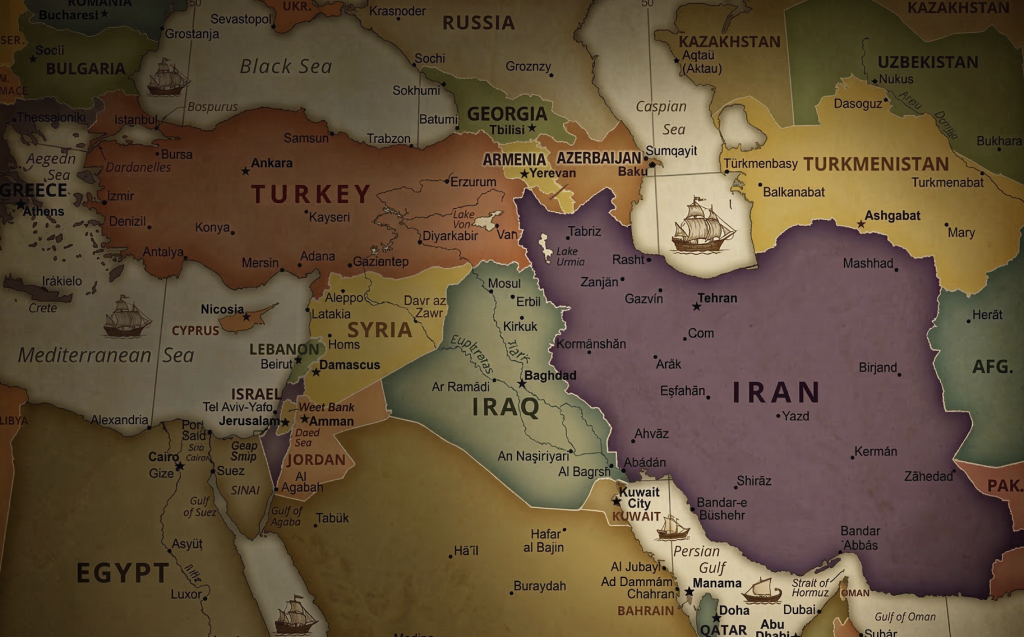
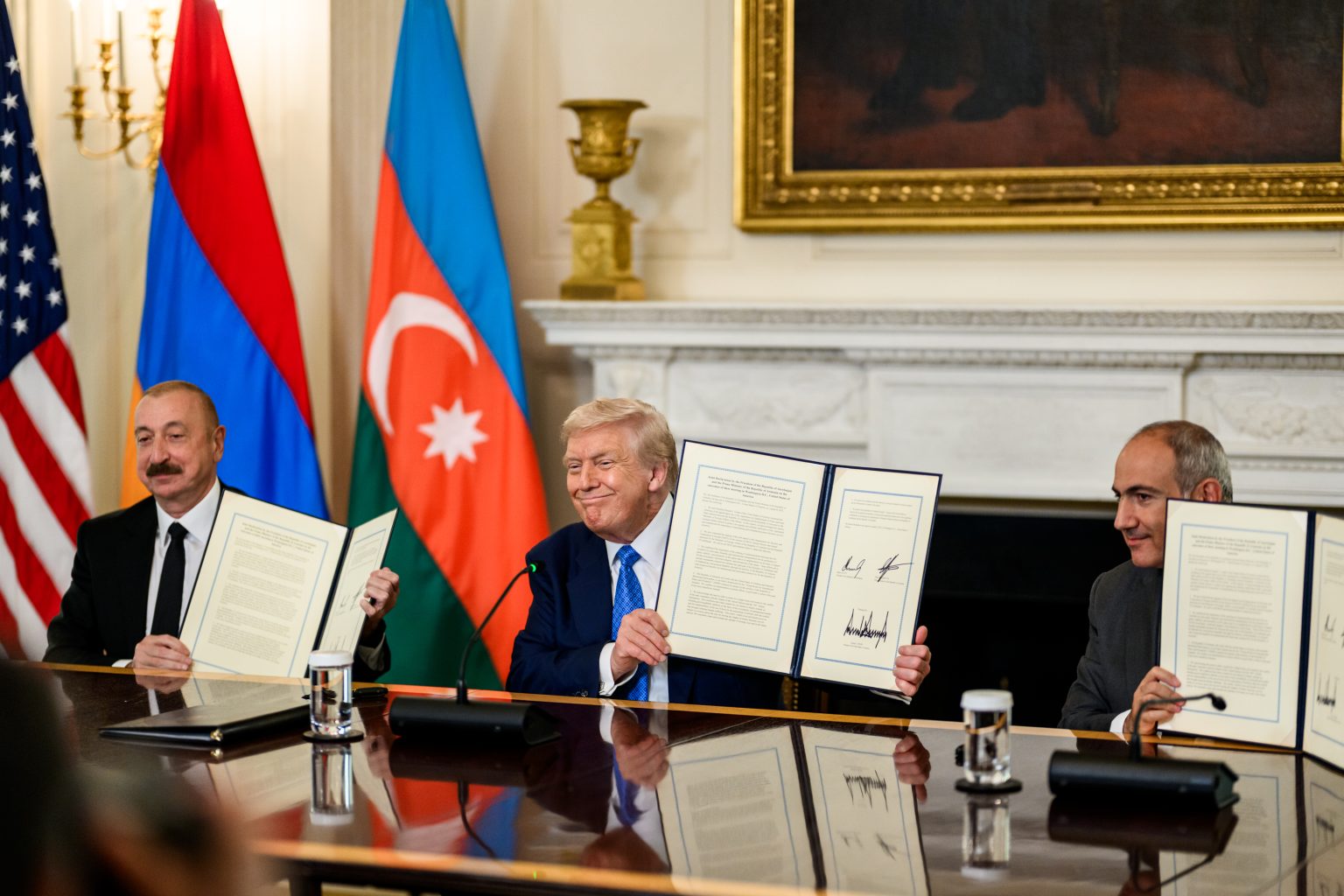
Of all the fronts in President Trump’s peacemaking agenda, the South Caucasus has delivered the most concrete results. The August 2025 Washington Declaration, signed between Armenia and Azerbaijan and witnessed by Trump, marked an important step toward peace in the region. The two sides initialed a peace agreement and advanced plans to unblock regional connectivity, including through the establishment of the Trump Route for International Peace and Prosperity (TRIPP), which would connect Azerbaijan to its Nakhijevan exclave through southern Armenia. Implementation of TRIPP has since made notable progress, but construction has yet to start. A breakthrough on those two tracks would, in turn, unlock Armenia–Türkiye normalization, transforming a long-fractured region into an area of trade and interdependence.
Achieving such breakthroughs, however, will require greater US diplomatic engagement to inject fresh momentum on both the Armenia–Azerbaijan and Armenia–Türkiye tracks. It will also need to address Tehran’s perceived concerns that TRIPP could alter the region’s geopolitical balance, undermine existing borders and state sovereignty, or open the door to a US military or security presence near its frontier. Without at least partly assuaging these concerns, the project will not only be difficult to implement but could also become a new source of regional tension, thereby failing to achieve its stated objective of delivering international peace and prosperity.
Connectivity in the South Caucasus has been one of the thorniest issues in Armenia–Azerbaijan negotiations since the 2020 Nagorno-Karabakh War. Following the conflict, Baku has sought to establish an extraterritorial connection to its exclave through Armenia, publicizing it as the “Zangezur Corridor.” Armenia rejected the corridor’s extraterritorial logic and, in 2023, countered with its “Crossroads of Peace” initiative, which called for the full unblocking of all communications with Türkiye and Azerbaijan, with routes operating under the sovereignty and jurisdiction of the countries through which they passed.
Multiple rounds of negotiations facilitated by Russia, the European Union, and the Biden administration between 2021 and 2024 brought Armenian and Azerbaijani positions closer but failed to secure a breakthrough. It was the Trump administration that broke the deadlock at the Washington Summit in August 2025. Rather than endorsing either an extraterritorial corridor or a conventional national route, the US proposal envisages creating a joint venture, the TRIPP Development Company, to build and administer the infrastructure, with the US holding a 74% stake and Armenia the remaining 26%. The other important feature has been that Armenia would retain full sovereignty and jurisdiction through the “back office,” while private operators would provide customer-facing services at the relevant border crossings through the “front office,” allowing Azerbaijan simplified access. This formula ultimately gave both sides sufficient political cover to sign the Washington Declaration.
Iran would prefer the route to be under full Armenian sovereignty and has strongly opposed the idea of a “Zangezur Corridor,” viewing it as a threat that could sever its physical connection to Armenia and, with it, cut off Iran’s access to Europe via Armenia and Georgia. As for TRIPP, Tehran’s initial reaction was mixed: hardliners vowed to prevent an “American corridor,” whereas President Pezeshkian and Foreign Minister Araghchi responded more positively, even if cautiously. More recently, Iran’s position appears to have become more conditional. Its ambassador to Armenia suggested that Tehran’s stance would depend on whether the project posed security, geopolitical, or geoeconomic threats, while reaffirming its readiness to engage with Yerevan. He also insisted that any regional transit or connectivity initiative must take the interests of regional actors into account and clearly define their role in related development programs.
Iran’s concerns must also be understood in the context of broader regional developments surrounding the country. Active US involvement in the South Caucasus, NATO member Türkiye’s growing regional role, Israeli–Azerbaijani security ties, and an increase in the United Arab Emirates’ engagement in the South Caucasus are all viewed in Tehran as elements of a broader US-led effort to encircle Iran. This reinforces Iran’s determination to resist any arrangement that could diminish its role in the Caucasus. The growing influence of a young, hard-line generation of Iranian leaders after the 2026 US–Israel–Iran War could increase Iran’s resistance to TRIPP.
Given the above, can Iran’s interests be disregarded? Formally, yes. Armenia and Azerbaijan can sign agreements with the US or any other country without Tehran. The United States can finance and manage infrastructure without Iranian approval. Other powers, such as the EU or Türkiye, can approve the project. But strategically, Iran cannot be sidelined. Its geography gives it staying power. Exclusion would not necessarily stop TRIPP, but it would make the project more contested, more securitized, and more vulnerable to regional backlash, thus harming the very objectives the Trump administration sought to achieve with its diplomatic breakthrough.
Besides the challenges surrounding TRIPP, Azerbaijan’s demand that Armenia amend its constitution has become another obstacle to progress on both the Armenia–Azerbaijan and Armenia–Türkiye tracks. The issue concerns the preamble to Armenia’s Constitution, which refers to the country’s 1990 Declaration of Independence. That declaration, in turn, cites the 1989 joint decision of the Soviet Armenia Supreme Council and Nagorno-Karabakh National Council on reunification. Azerbaijan is making the removal of this reference from the constitution a precondition for signing the bilateral peace agreement initialed in Washington.
Türkiye backs Azerbaijan’s position. Although the recent Armenia–Türkiye normalization process has yielded several positive results, the land border remains closed. On June 18, Turkish foreign minister Hakan Fidan credited Armenia with taking important steps toward normalizing relations with Türkiye, while insisting that Yerevan still needs to take additional action. Ankara, he suggested, is ready to move forward once the necessary conditions are in place, most likely a reference to Azerbaijan’s precondition.
Those preconditions complicate US peacemaking efforts. That is because constitutional changes in Armenia require the agreement of a two-thirds majority of the Parliament, and subsequent approval by referendum. Prime Minister Pashinyan’s ruling party, which recently secured a victory in the June 2026 parliamentary elections, does not have such a constitutional majority. This dynamic traps the region in a vicious circle, as Azerbaijan’s precondition delays the peace agreement, which in turn hinders Armenia–Türkiye normalization, with both delays undermining TRIPP.
To secure President Trump’s legacy as a peacemaker in the South Caucasus, his administration needs to ramp up its engagement in the coming months. This should include intensive negotiations with Armenia, Azerbaijan, and Türkiye to advance the signing and ratification of the peace agreement and the full opening of the Armenia–Türkiye border, before the midterm elections and the start of the 2028 presidential campaign cycle, which reduce Washington’s attention span.
US efforts should also address Azerbaijani and Turkish preconditions. While acknowledging Azerbaijan’s concerns regarding the wording of the Armenian constitution and the 1989 joint decision, the US should make it clear to Azerbaijan, Türkiye, and Armenia that it wants to get the peace process over the finishing line. The timing for greater US diplomatic engagement may, in fact, be particularly favorable. Azerbaijan has recently signaled some flexibility as to how its concerns might be addressed. In an interview, Hikmet Hajiyev, assistant to the Azerbaijani president and head of the presidential foreign policy department, indicated that Baku’s priority was the formal removal of provisions it regards as territorial claims, “whether through a new constitution or another legal mechanism.”
While Hajiyev did not elaborate on what those “legal mechanisms” might entail, one potential alternative would be to repeal the 1989 joint decision of the Supreme Council of Soviet Armenia and the Nagorno-Karabakh National Council, rather than amend Armenia’s constitution. This option was discussed first in 2022 during a Track 2 dialogue between Armenian and Azerbaijani experts, attended by one of the co-authors of this article as a leading Armenian expert, and could now be revisited and developed into a possible way forward.
Repealing the 1989 joint decision could be politically fraught for Armenia, as any Azerbaijani demand on Armenia’s political and legal corpus could antagonize society and trigger a domestic crisis that might itself endanger the peace process. Even so, it remains more feasible than constitutional change. This suggests that Washington may have greater room to broker a solution that addresses Azerbaijan’s concerns without tying the peace process exclusively to a new constitution.
As for TRIPP, a viable path exists to ensure that it does not become another point of US–Iran friction or jeopardize President Trump’s diplomatic breakthroughs, regardless of how long the Middle East peace negotiations between Washington and Tehran take or what they ultimately achieve.
The solution lies in Washington and Yerevan providing Iran with clear guarantees that TRIPP will not involve any US military or security presence along Armenia’s border with Iran, whether through American state agencies or private contractors. According to several senior US diplomats in Armenia, this is already Washington’s intention. But it must be communicated through high-level US–Iran talks, and not just left for Armenian officials to convey. Armenia should double its efforts, as Iran is not a marginal neighbor. It is a vital one, a trade route, an energy partner, and a strategic hedge. Yerevan, for instance, could initiate technical consultations with Iran on border procedures, rail compatibility, customs transparency, and protection of the existing Iran–Armenia crossing. Armenia’s message should be simple: TRIPP will not close or negatively affect Iran’s borders with Armenia.
In sum, Washington should continue to back Armenia–Azerbaijan peace and regional connectivity, but it should also make clear that TRIPP is neither a military project nor a platform for pressure against Iran. Armenia, for its part, should insist on full sovereignty over its land while preserving its border and energy ties with Iran. Azerbaijan and Türkiye should avoid maximalist corridor language and accept that connectivity works best when it is mutually beneficial rather than exclusionary. Iran, for its part, should recognize that opposing every US-backed project will not restore its influence. Its best option is to compete economically: invest in Armenia, expand north–south transit and turn its geography into a positive asset rather than merely a defensive red line.